What this service covers
Fan-driven sub-slab and sub-membrane systems designed for the foundation in front of you: a shirtwaist-era stone basement in Brookside, a Prairie Village block basement with a sump, a Johnson County poured walkout, or a ranch that mixes all three. Installs follow ANSI/AARST SGM-SF-2023 everywhere in the metro; on the Kansas side the mitigation technician holds KDHE certification under K.S.A. 48-16a01 et seq., and on the Missouri side the credential behind the work is a current NRPP or NRSB certification you can verify yourself. Every system ends with a post-install retest.
Typical pricing
$1,200-$2,500
Pricing varies by job specifics. Free phone or on-site quotes; fixed pricing once the technician has assessed the job.
What an active sub-slab system does under a Kansas City house
Radon rides the soil gas, and soil gas follows pressure. Through a long stretch of the year a heated Kansas City house runs at slightly lower pressure than the ground it sits on, so gas drifts up through the floor-wall joint, slab cracks, sump pits, and the seams of stone and block walls. A mitigation system reverses that arithmetic: a suction cavity is cored through the slab, sealed pipe carries the airflow to a fan mounted in the attic, in a garage with no room above it, or outdoors, and the fan holds the soil beneath the slab at lower pressure than the basement. The gas takes the pipe and exits above the roofline instead of seeping into the house.
The EPA's Consumer's Guide to Radon Reduction rates active sub-slab suction at 50 to 99 percent reduction, which is why it is the default fix for the basements this metro is full of. Sealing is the supporting act, not the fix: the floor-wall joint, reachable cracks, and the sump lid get closed so the fan spends its suction on the soil rather than on conditioned basement air.
What separates a system that holds its number from one that drifts is diagnostics before the core drill. Sub-slab material varies block to block here, from river-bottom sand near the Missouri and Kaw to tight clay over limestone benches in Shawnee and south Overland Park, and a communication test tells the design whether one suction point will reach the whole slab or a second is needed. The pricing breakdown shows how those findings become line items.
One metro, two rulebooks: Kansas certifies, Missouri does not
The Kansas City metro is one housing market under two radon regimes, and knowing which side of State Line Road a house sits on changes how you vet the work. Kansas requires certification for radon work done for pay: under K.S.A. 48-16a01 et seq., measurement and mitigation technicians are certified through the Kansas Department of Health and Environment, and KDHE publishes its certified professionals so a homeowner in Olathe or Lenexa can check a name before signing anything.
Missouri runs an informational radon program and no licensing program at all. Nothing in state law stops anyone with a truck and a drill from selling mitigation in Independence or Liberty. The protection a Missouri-side homeowner has is the national credential system: the National Radon Proficiency Program (NRPP) and the National Radon Safety Board (NRSB) both certify individuals, both publish searchable registries, and a current certification number is the thing to require in writing before work starts.
Every install arranged through this site carries the right paper for its side of the line: KDHE certification on Kansas jobs, and verified NRPP or NRSB credentials on Missouri jobs, with ANSI/AARST SGM-SF-2023 as the installation standard everywhere. The verification guide walks through checking each registry in a few minutes.
How the metro's housing stock shapes the design
Kansas City is a basement metro, and the basements span 120 years. The 1900s to 1920s shirtwaist and bungalow blocks of Brookside, Waldo, Strawberry Hill, and the Northeast sit on stone or clay-tile walls with floors poured in sections, which means more sealing scope, sometimes a communication test, and occasionally a second suction point. The postwar rings, Prairie Village, Raytown, Gladstone, north Overland Park, are 1940s to 1970s ranches and Cape Cods on block walls, where soil gas moves through every mortar joint and the top course, and where sump pits added during decades of water management need airtight, serviceable covers.
Split-levels and raised ranches in Blue Springs and Shawnee stack a half-buried lower level beside a garage slab and sometimes a crawl, three entry paths one design has to cover. The 1990s and newer poured basements of Lee's Summit, Olathe, and south Overland Park are the straightforward cases, often one-day installs, and some carry a builder's passive pipe that only needs a fan.
Walkouts deserve their own sentence because the metro's rolling terrain produces so many: a walkout still has two or three buried walls and a slab in full ground contact, and the buried side tests high just like a full basement. The service-area notes carry the street-level detail for each city.
The quote, the install, and the number that proves it worked
Most Kansas City basement and slab systems land between $1,200 and $2,500 installed; crawl spaces that need a sealed membrane run $1,800 to $3,500, and activating a builder's passive pipe runs $700 to $1,200. The quote is written and fixed after the assessment visit, and it names the parts that matter: suction-point count, pipe route, fan model and location, sealing scope, discharge height, and the credential of the person doing the work, KDHE number on the Kansas side, NRPP or NRSB number on the Missouri side.
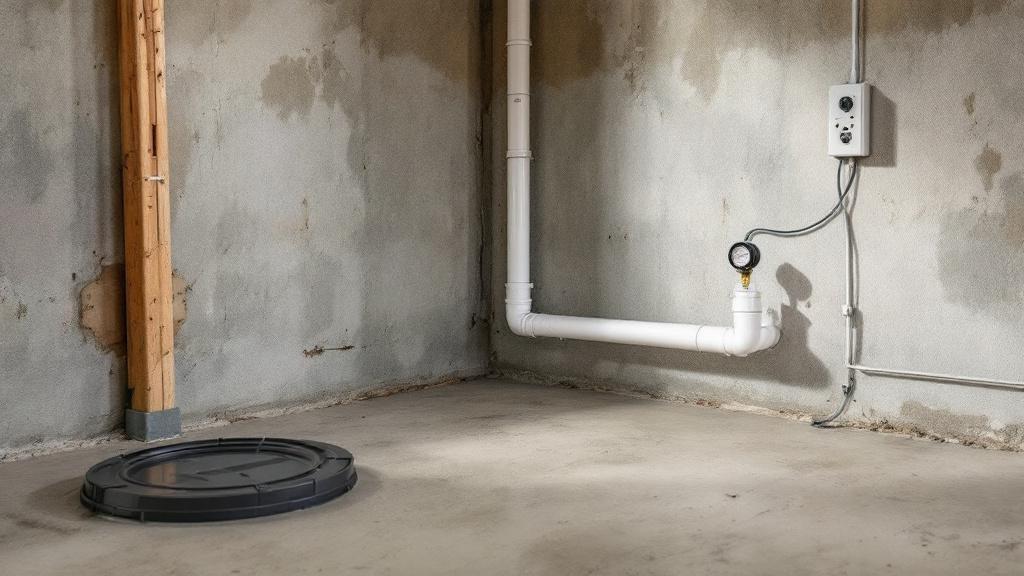
The install itself is usually a single day. The fan never goes in the basement or a lived-in room; the discharge ends above the eave, away from windows and doors; the pipe gets a manometer so you can read suction at a glance; and the sump, if there is one, gets an airtight cover that still lifts for pump service.
The system is not finished until a retest says so. A post-install test under closed-house conditions, at least 48 hours, is part of every job, and the written result goes in your records next to the quote. That report is worth real money later: buyers' agents on both sides of the line ask for it, and a dated retest beats any verbal assurance. See what your result means and the cost FAQ.
Service area
Radon Mitigation Systems is available across the Kansas City metro on both sides of the state line. Per-suburb pages: